
art ↔ i/o bound
Q: How do you transfer a mind over a wire?…
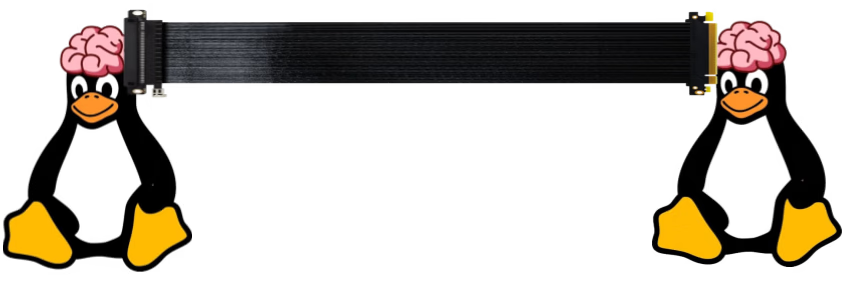
If physical Turing machines want to talk to one another, their tapes must be physically connected. Which can be any medium, from electrons in a copper wire to photons in a vacuum. Once connected, they must speak the same language to make heads or tails of the wire; in other words, message passing between hosts requires:
- A medium to move blobs, and
- A pre-determined serialization scheme.
The receiver reconstructs the signal on the interconnect on their own tape. This can be any L2 protocol, but the most beautiful one we’ve discovered to date is remote direct memory access (RDMA): sender and receiver treat each other’s memory as their own, with an RDMA driver maintaining the illusion. Kernel is none the wiser. If both sides agree on how to serialize, then the message passing algorithm is always as follows:
- Sender marshals their message to an in-memory array,
- writes that byte array into an RDMA-registered buffer,
- and issues an RDMA WRITE pointing at that buffer.
- Then receiver reads their own memory and unmarshals with protobuf.
Zero copies.
(Notice that I used the async WRITE verb over the
sync SEND. This matters soon)
The original x86 machine, the Intel 8086, could address 220 bytes. With 16-bit registers and the infamous (segment << 4) + offset addressing scheme, its 1 MB “tape” was effectively infinite, like saying a billion trillion stars. No one expected the programmer to come close to this. High-capacity DRAM was expensive, and most computers shipped with just 16-64 KB of the good stuff.
If two 8086s wanted to talk to each other in the year 1978, the fastest wire would be ARPANET at 50-56 kb/s. Without RDMA, they’d have to message pass in userspace. Totally unusable.
Now what if they wanted to talk in the year 2025? It’s a rare find to find even one of them intact, but let’s humor this. They think slow: their 5 MHz clock is millions of times slower than a common gaming CPU like the i7-14700K. No pipelining, SIMD, out-of-order, or branch prediction. Not even an L1 cache.
But they’d get to talk over our SOTA interconnects. Their sloth compute is actually an advantage here, because the message sends faster than they can think. They don’t need to gzip, they don’t even need to be picky about which buffers they send; they can literally read each other’s minds in real time, reducing to a single TM in polytime.
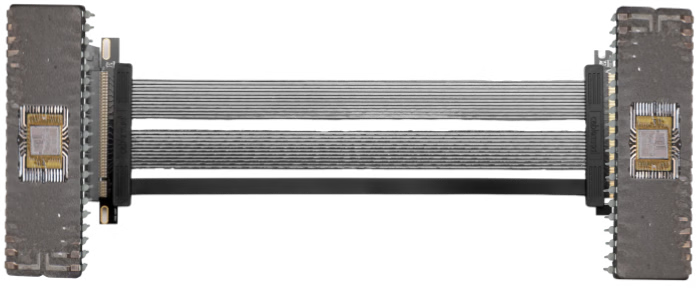
package 8086;

message RAM {
  bytes data = 1;
}
There’s our wire, and there’s our protobuf. The latter encapsulates the tape on which the TM head reads: everything but the regfile. Including all virtual addresses spaces of user processes. Each page table is itself just an ordinary physical frame bundled with data.
The former is our fastest interconnect: PCIe 6x16. At 64 GB/s bidirectional, they could transfer a RAM message in at most 16.2 µs (really in 25 ns since their physical memory often topped out at 64 KB). That’s faster than a single memory read on their ancient NMOS RAM, orders of magnitude faster than a floppy disk read. It’s not instant (that would violate locality), but it’s imperceivable. It’s not art.
Time skip 50 years into the future…
The ancient hardware in question which demands to communicate losslessly and with imperceptible latency is now a human boy named Pyrus.
package pyrus;

message Particle {
  string id                   = 1;
  double mass                 = 2;
  string field                = 3;
  double charge               = 4;
  double radius               = 5;
  Vec3 position               = 6;
  Vec3 velocity               = 7;
  repeated Complex spin   = 8;
  repeated double quantum_numbers = 9;
}

message Pyrus {
  double time                 = 1;
  repeated Particle particles = 2;
}
Unlike his cousin the 8086, Pyrus does not follow the rigid Von Neumann abstraction. The tape and head of his TM are tangled in an ungodly high dimensional latent. He feels that every attempt at serializing himself is lossy, save for one: a chunk of the 4D manifold. Now he found someone with whom he wishes to share his tape.
Particle has a variable size due to his repeated fields. But let’s make some sane assumptions to estimate just how complicated he is. Let’s say particle IDs and fields are short (like “e1” and “electron”). Every double is IEEE-754 = 8 bytes. Let’s limit 2 spinors and 4 quantum numbers. Summed up, a Particle message is on the order of 150 bytes.
Now for Pyrus. Let’s floor his granularity at the hadron level. If we treat his 160 lbs mostly as water, that gives us 7.25 * 1027 atoms. In the atoms of bulk matter, there is an equal number of protons, neutrons, and electrons. He is roughly half hydrogen, a quarter oxygen, a tenth carbon, a hundredth nitrogen, and all else trace. Therefore, his atoms have a weighted average of (.5 * 1 + .25 * 16 + .1 * 12 + .01 * 14) = ~6 nucleons, and 3 electrons. This gives him 7.25 * 1027 * 9 = 6.5 * 1028 Particle messages. This means each Pyrus message is roughly 9.79e31 bytes, or ~10… quettabytes.
Tough luck. Though 2075 is well into post-singularity, there are very few branches of the multiverse that reach quettabit wires by then. Though if they were to have such a wire, and the RDMA driver wrote not merely electrons into capacitors but particles into space, that would be teleportation. But that kind of SNR requires an energy source and medium that contradicts 2025’s understanding of physics.
Yet all is not lost for Pyrus! Let’s assume that most of what makes his meat interesting lives in his prefrontal cortex. In other words, a tiny subset of the distribution is responsible for most of his variance. The rest can be learned with a relatively low dimensional latent, i.e. LoRA. His schema could then become:
// ---------- Fundamental abstractions ----------

message SpatialIndex {}
message ActivityField {}
message ConnectivityMap {}
message CellPopulationMap {}
message MicrocircuitModel {}
message NeuromodulatoryField {}
message PlasticityProfile {}

// ---------- Regional unit ----------

message PFCRegion {
  string id = 1;
  SpatialIndex layout = 2;
  CellPopulationMap cells = 3;
  ConnectivityMap intrinsic = 4;
  ConnectivityMap extrinsic = 5;

  ActivityField baseline_activity = 6;
  ActivityField task_activity = 7;

  MicrocircuitModel local_model = 8;
  NeuromodulatoryField neuromod = 9;
  PlasticityProfile plasticity = 10;
}

// ---------- Entire prefrontal cortex ----------

message PFC {
  repeated PFCRegion regions = 1;
  ConnectivityMap global_connectivity = 2;
  NeuromodulatoryField global_neuromod = 3;
  PlasticityProfile global_plasticity = 4;
  MacroDynamics dynamics = 5;
}
Our message size has increased by an order of magnitude, but the number of messages has decreased by several. A PFC can be later compiled to a Pyrus, but storing it in the higher abstraction format reduces both tokens and encode/decode cost per token. Thus, we have decreased model size at the cost of accuracy. That’s the bias-variance tradeoff.
To be on par with shared memory, an RDMA WRITE needs to have lower wire latency than a memory access. I.e. invisible to human perception. Let’s work backward from our soft real time latency budget to see what kind of wire he needs to have for PFC. Let’s set the brains cognitive window to a somewhat empirical range: \(W \in [5\,\text{ms}, 25\,\text{ms}]\)
The closed loop latency is
\[T_{\text{loop}} = T_{\text{encode}} + T_{\text{transmit}} + T_{\text{apply}} + T_{\text{decode}}\]
With our arbitrarily fast interconnect, we force the remaining terms to bottleneck. Then the condition becomes:
\[T_{\text{encode}} + T_{\text{apply}} + T_{\text{decode}} \ll W \quad (\text{if } T_{\text{transmit}} \to 0)\]
Even with instantaneous links, ‘speed-of-thought shared cortex’ requires the remote’s encode→apply→decode loop to complete inside his brain’s ~5–25 ms coordination window; otherwise it’s experienced as an external tool, not a literal extension of self. But under happy path closed loop, the boundary between participants dissolves. Let’s call this interconnect Peripheral Component Interface Runway, or PCIr.
If we restrict each PFC message to 10 GB (for reference, that’s a 10 billion parameters at int8), and the cognitive window to 10 ms, then the absolute lower bound link rate must be:
\[B = \frac{10\,\text{GB}}{10\,\text{ms}} = 1\,\text{TB/s} = 8\,\text{Tb/s} \quad (\text{practical target} \approx 16\,\text{Tb/s})\]
That’s exactly as fast as NVLink-C2C. The bottleneck comes when we introduce distance, especially if we want it wireless. It’s not instant (that would violate locality), but it’s imperceivable. It’s still not art.
Again, this is only for a lossless encoding, a conceptual “here’s everything I am, do with me what you will” codec. Any lossy compression he applies on the local side, even if it makes him claustrophobic, can reduce the package size by orders of magnitude. The tradeoff is increased decoder cost, the same way its harder to decode poetry than prose.
But then he wakes up in the year 2025,
package song;

message PCM {
  uint32 sample_rate = 1;
  uint32 channels    = 2;
  uint32 bit_depth   = 3;
  bytes data         = 4;
}
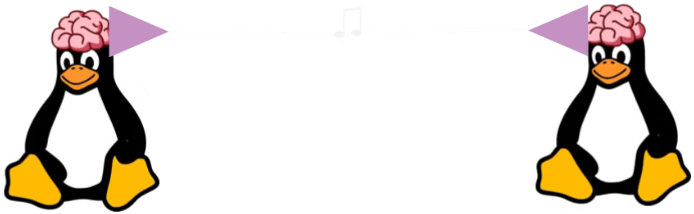
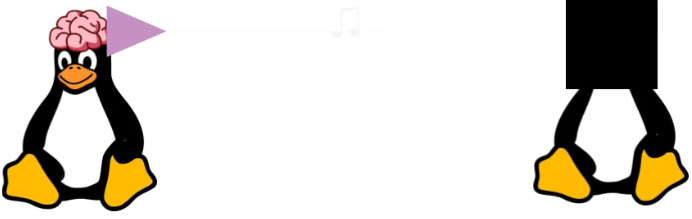
Disoriented, there is no more tape sharing, PCIr, nor petabit/sec wires: only bits/sec wires like “music” and “poetry.” How does he tell you that he isn’t from here? That he’s from a time where there wasn’t this hard boundary between you and him, and he needs to go back.
He’s forced to haphazardly encode his packets before the RDMA WRITE on the bytes/sec wire, fingers crossed that meaning survives the remote’s decoder. He’s not quite conscious of how he encodes thought into medium, so he can’t control it with rigor. Throughout his creative process he leaks intent by getting distracted and overwhelmed; what he does write falls insultingly short of what he meant. Intent, like medium, gets destroyed not by noise but by well-intentioned compression.
Take the trombone. First the abstract idea in the PFC needs to lower to simpler motor neurons, then into lip movement in a mouthpiece, coordinated with the hand motor neurons, and rectified into air. Of course there are many passes I glazed over, but in all, they are finite. They are clunky, and hard to control. He could spend many lifetimes training his motor neurons how to wield the trombone encoder when what he really meant was to share his neurotransmitter state.
The best he can do is find a better behaved encoder on his side: to make sure that the bytes he sends captures most of the variance of the thought that provoked them. This is most efficiently captured by bits, not molecules. But the PCM protobuf is inefficient for human thought. It’s uncompressed samples, burying intent under many dimensions of noise. So he needs to perform PCA.
package solo;

message Note {
  float pitch_hz         = 1;
  float start_sec        = 2;
  float duration_sec  = 3;
  enum Articulation {
        LEGATO              = 1;
        STACCATO            = 2;
        ACCENT              = 3;
        TENUTO              = 4;
        GHOST               = 5;
  }
  Articulation articulation = 4;
  float air_pressure = 5;
  float slide_position = 6;
}

message TromboneSolo {
  string title = 1;
  repeated Note notes = 1;
}
Just like with PFC, we’ve increased the size of a message by an OOM but decreased their number by several. But now we’ve gone too far the other way. The density has increased but the intent of the message has been diluted: there are too many ways to play a solo. Maybe a better proto is CELT, maybe SILK. Certainly one that hasn’t been written yet.
Of course, he doesn’t even know if the person listening to his music and poetry is human. He doesn’t need to; they just need to walk like a human and talk like a human. It’s the same manner that an x86 blob doesn’t care if its read by an 8086 or a core i9-1990k: what matters is ISA compatibility. You can only speak your mind and cross your fingers that they’ll feel what you feel. That’s why it’s really an RDMA WRITE and not SEND; there’s no guarantee that anyone is cooperating on the other side, or interpreting you the way you do in your head. Yet we choose to speak anyway, even if into the void.
Still, he can say more than he thinks with bytes/sec. So he searches for the lowest-loss lowering scheme before sending out his packets. The format of NeuraLinux will grow into video, tastes, metaverses; never arriving, but ever in pursuit of the sublime. And at this point, Pyrus realizes his goal of shared memory was flawed from the start. If he was able to express himself losslessly with imperceptible latency. Then what? Perhaps the point was not fidelity, but in endless pursuit of a higher compression ratio. To find the encoder/decoder pair and protobuf that maximizes recall with minimum length. Not for efficiency’s sake, but to decide for himself what is signal and what is noise. Because art says something. And we need to imbue the message with certain human-specific patterns to bypass the biases and filters of the decoder, like smuggling a thought grenade in a briefcase.
Introducing ChINAR
ChucK Integrated NL→Audio Rectifier
A: By explicitly modeling intent recall & density while lowering.

package ChINAR;

message Instrument {
  enum Osc {
        SINE     = 0;
        SAW      = 1;
        SQUARE   = 2;
        TRIANGLE = 3;
        NOISE    = 4;
        BLIT     = 5;
  }
  Osc osc       = 1;
  double detune = 2;
  bool reverb   = 3;
  double gain   = 4;
  Envelope env  = 5;
  Filter filter = 6;
  LFO lfo       = 7;

  // Timbre complexity hook for the frontier knob.
  double complexity = 8;
}

message Voice {
  Instrument instrument = 1;
  Pattern pattern       = 2;
  double offset         = 3;
  double pan            = 4;
}

message Piece {
  double tempo          = 1;
  repeated Voice voices = 2;

  // Global frontier knob
  double complexity = 3;
}
Current cross-modal transformations preserve surface features but discard latent intent. This produces outputs that are formally correct but phenomenologically wrong. Therefore, he must explicitly model intent to increase the signal to noise ratio on the wire.
Soft-real-time =
  Speech
   (120ms)   → Text
   (200ms)    → TOML DSL
   (10ms )     → Proto Validation
   (30ms )      → Transformations
   (40ms )       → ChucK
   (100ms)        → Audio
                                = 500ms
Just as a chain is as strong as its weakest link, a latent has as much information as its smallest bottleneck. That’s why the every encoder monotonically decreases width. Projecting into higher dimensions afterward does not increase recall; it only dilutes density superlinearly; that’s the curse of dimensionality. This is what he’s been missing when he sits down to write a poem: he tries to write the final draft first, or overthinks and prematurely optimizes, or multitasks with unnecessary side quests. That’s why Pyrus must be explicit when he does reduce width, preferring isomorphic transformations in the middle.
He’s stuck with these analog, lossy interconnects for the time being. This will change in course as he approaches PCIr, but he must be patient. In the meantime he incurs huge encode costs, transfers on noisy wires, but his messages become insanely compressed as a result. It’s not instantaneous (that would violate locality), it’s not remotely imperceptible.
It’s art.